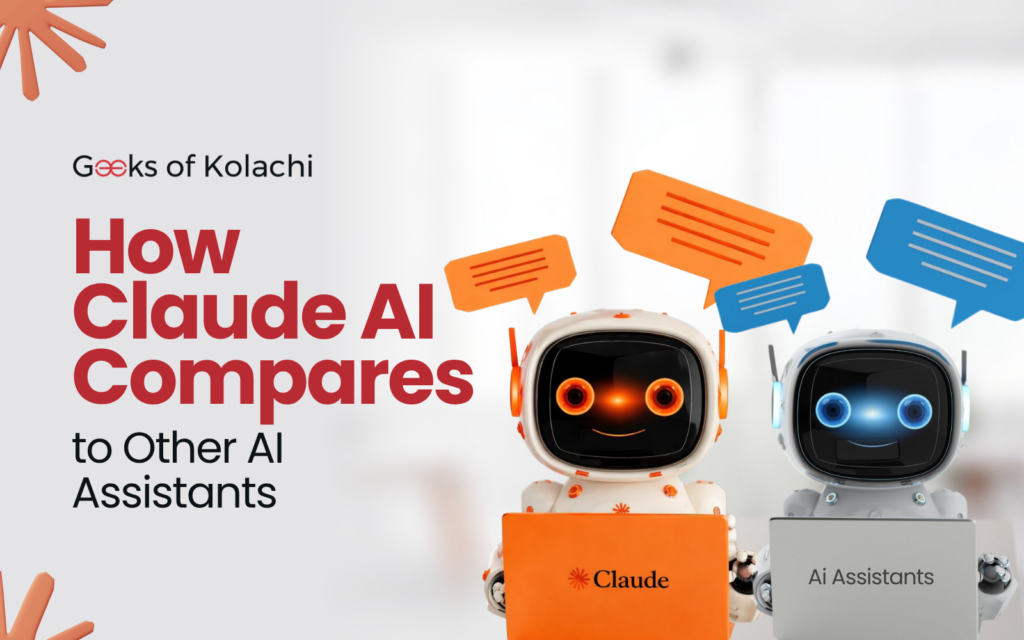
How Claude AI Compares to Other AI Assistants
Choosing an AI assistant in 2026 feels a bit like trying to pick a streaming service: they all have good stuff, they all have gaps, and you will probably end up using more than one depending on what you are doing. Here is how Claude stacks up against the main alternatives, without the fanboy nonsense.
The Main Players
The AI assistant market has settled into a handful of major options that dominate actual usage. Claude (from Anthropic), ChatGPT (from OpenAI), Gemini (from Google), and a handful of more specialized or open-source alternatives. This comparison focuses primarily on Claude vs ChatGPT since that is the matchup most people care about, with some notes on the others.
Claude AI vs ChatGPT: The Core Comparison
This is the question people mean when they ask “is Claude AI or ChatGPT better?” Let us go through the key dimensions.
Writing quality: Claude is widely considered to have an edge here. It produces more natural, nuanced prose with fewer of the telltale AI-isms that make text sound robotic. It is better at maintaining a consistent tone throughout a long document, better at following style constraints, and better at capturing voice. Writers, marketers, and content creators who have tried both tend to prefer Claude for text-heavy work.
Instruction following: Claude is notably better at holding multiple constraints simultaneously. If you give it a complex prompt with several specific requirements, it tends to honor all of them rather than drifting from some partway through. This matters for professional use cases where precision is important.
Coding: Both Claude and ChatGPT are strong here, and opinions vary among developers. Claude tends to write clean, well-explained code and is good at methodical debugging. ChatGPT has a slight edge in some ecosystems due to integrations with tools like GitHub Copilot. For most coding tasks, either works well. Which Claude AI is best for coding? Among Claude’s own models, Opus for complex architecture, Sonnet for everyday development.
Image generation: ChatGPT integrates with DALL-E and can generate images directly in the chat. Claude cannot generate images at all. If image generation is important to your workflow, this is a concrete advantage for ChatGPT.
Honesty and calibration: Claude is designed to express uncertainty rather than confabulate. This is a philosophical difference in how Anthropic built it. Claude will more readily say “I am not sure about this” or “you should verify this” compared to some alternatives that confidently assert things that turn out to be wrong. For research, analysis, or anything where accuracy matters, this is a significant point in Claude’s favor.
Ecosystem and integrations: ChatGPT has been around longer and has a broader ecosystem of third-party integrations and plugins. Claude is expanding rapidly, but if you need Claude to connect to specific external tools, check what is currently available before assuming it exists.
Context window: Both have impressive context windows in 2026. Claude’s context window is notably large, which makes it strong for long-document tasks. This has historically been one of Claude’s clearer technical advantages.
Claude vs Google Gemini
Gemini is Google’s AI assistant and it has one significant structural advantage: deep integration with Google’s ecosystem. If you live in Google Workspace, Docs, Gmail, and Sheets, Gemini can work within those tools in ways Claude currently cannot by default.
For pure AI capability, Claude and Gemini are competitive. Claude tends to perform better on nuanced writing tasks. Gemini has real-time web access integrated natively, which Claude does not have by default. For factual queries about current events, Gemini has an advantage.
For coding, analysis, and creative writing, Claude competes strongly with Gemini and often comes out ahead in head-to-head quality comparisons.
Claude vs Open Source Models
Models like Llama, Mistral, and others are technically “free” in that you can run them yourself without paying per query. They have genuine advantages for privacy-sensitive use cases since the data never leaves your machine.
However, for most users who do not want to manage infrastructure, the quality gap still exists. Claude and other frontier models generally outperform open-source alternatives on complex tasks. The gap is narrowing, but for demanding professional use cases, Claude still has an edge.
Is Claude AI Safe Compared to Alternatives?
Safety is one of the areas where Claude was explicitly designed to stand out. Anthropic built Claude using Constitutional AI methods, which means Claude has a principled framework for evaluating its own responses rather than just pattern-matching on training data. This results in fewer bizarre or harmful outputs, more consistent refusal of genuinely dangerous requests, and more reliable behavior in edge cases.
For businesses deploying AI in customer-facing contexts, this reliability and predictability is not a nice-to-have. It is a requirement. Claude’s safety track record is genuinely good, and Anthropic’s public commitment to AI safety research gives it a different kind of credibility compared to companies for whom safety is more of a compliance exercise.
Does Claude AI Train on Your Data?
A legitimate concern when comparing AI services. By default, Anthropic may use conversations to improve Claude, similar to how most AI services operate. For sensitive professional or personal data, it is worth reviewing Anthropic’s current privacy policy and adjusting your settings accordingly. Enterprise plans typically include stronger data privacy protections.
This consideration applies to all AI services, not just Claude, and comparing the privacy policies of each before entrusting them with sensitive work is a reasonable step.
Who Should Use Claude?
Based on honest comparison, Claude makes the most sense as your primary AI assistant if you do a lot of writing and want the most natural output, if you work with long documents and need a large context window, if instruction-following precision matters to your use case, if you value consistent, predictable behavior over flashiness, or if you are doing coding work and want clear explanations alongside the code.
You might reach for ChatGPT instead if you need image generation natively, if you need deep integration with specific third-party tools that only connect to GPT, or if your team is already heavily invested in the OpenAI ecosystem.
The Actual Answer
Is Claude AI good compared to the alternatives? Yes, it is among the best available. For most text-based professional tasks, it is competitive with or better than the alternatives, and on writing quality specifically it stands out from the field. The free tier makes it low-risk to try, and the paid plan is fairly priced given what you get.
Use the tool that works for your specific tasks. For many people, that tool is Claude.
Read More:
Stop Building Features Nobody Asked For