
Why Your SaaS Isn’t Scaling (And the Brutal Fix)
You launched your SaaS product. Users signed up. Maybe even paid. Early traction looked promising.
Then growth slowed.
Customer acquisition costs increased. Retention plateaued. Infrastructure started feeling strained. Feature requests piled up. Revenue did not accelerate the way projections suggested it would.
This is the stage where many founders assume the issue is marketing.
In reality, SaaS products often fail to scale because of structural problems in product architecture, validation, or development strategy. Scaling is not about adding more features or increasing ad spend. It is about whether the foundation of your SaaS app development was built for growth in the first place.
If your SaaS is not scaling, the fix is rarely cosmetic. It is usually architectural.
Let’s break it down.
The Three Core Reasons SaaS Products Fail to Scale
Most scaling failures fall into three categories:
- Weak product-market fit
- Over-engineered early architecture
- Reactive development instead of strategic development
Each one compounds the other.
1. Weak Product-Market Fit Disguised as “Early Traction”
Early signups are not proof of product-market fit.
True product-market fit shows up in:
- Strong retention
- Consistent usage
- Organic referrals
- Clear willingness to pay
If your churn rate is high or engagement drops after onboarding, the issue is not scaling. It is validation.
Many SaaS founders move into aggressive growth mode before stabilizing retention metrics. That creates the illusion of scaling while quietly increasing churn.
Scaling a leaky product only amplifies loss.
- Overbuilt Architecture Too Early
Another common issue in SaaS app development is building for hypothetical scale before actual demand exists.
Founders often request:
- Microservices from day one
- Complex role-based systems
- Deep analytics dashboards
- Advanced automation
- Multi-layered infrastructure
All before validating core usage patterns.
The irony is this: early complexity often slows down iteration. It makes feature updates harder, debugging slower, and deployment riskier.
A product built with rigid architecture too early becomes expensive to evolve.
Scalable systems are designed with growth in mind, but they are not engineered like enterprise platforms on day one. There is a difference between scalable design and premature complexity.
3. Reactive Development Instead of Structured Roadmapping
Scaling requires direction.
If your development roadmap is driven by:
- Loud customer requests
- Competitor features
- Internal assumptions
- Sales pressure
Then your SaaS becomes fragmented.
Strategic SaaS development services focus on:
- Cohesive feature expansion
- Performance optimization
- Data-driven improvements
- Infrastructure readiness aligned with growth
Without roadmap discipline, your product becomes heavy but not stronger.
The Brutal Fix: Simplify, Stabilize, Then Scale
If your SaaS is not scaling, the solution is not “add more.” It is almost always “refine what exists.”
Here is the structured approach that works.
Step 1: Audit Retention Before Acquisition
Before investing more in growth, analyze:
- 30-day retention rate
- Feature usage frequency
- Time-to-value during onboarding
- Churn reasons
If users are not consistently returning, scaling traffic will not fix the issue.
This stage may require refining onboarding flows, simplifying UI, or narrowing feature sets.
Step 2: Reduce Architectural Drag
If your product feels slow to update or expensive to maintain, you may need to evaluate your technical stack.
This does not necessarily mean rewriting everything. It means identifying:
- Bottlenecks in deployment
- Overcomplicated services
- Performance issues
- Redundant systems
Strong custom app development practices ensure the architecture evolves alongside usage, not ahead of it.
Step 3: Align Features With Revenue Drivers
Every feature in your SaaS should either:
- Improve retention
- Increase revenue
- Reduce operational cost
If it does not serve one of these outcomes, it is noise.
This discipline is critical in software development for startups, where runway determines survival.
When to Rethink Your SaaS Development Strategy
There are specific warning signs that indicate your SaaS development approach needs restructuring:
- Development cycles are getting longer.
- Bug fixes take weeks.
- Feature releases break existing workflows.
- Infrastructure costs rise faster than revenue.
- Customer churn remains unresolved.
These signals suggest the foundation may need refinement.
In many cases, bringing in experienced SaaS development services with startup scaling experience can identify inefficiencies quickly. Fresh architectural perspective often reveals blind spots internal teams miss.
Resource for SaaS Founders

If your SaaS feels heavier than it should, this guide walks through product structure, pricing logic, scaling decisions, and architectural planning designed specifically for founders navigating growth challenges.
It provides a practical lens on building SaaS without unnecessary complexity.
The Role of AI in Scaling SaaS
AI-driven features can enhance SaaS platforms when integrated strategically. However, adding AI to compensate for weak retention or unclear positioning rarely solves the underlying problem.
AI app development works best when layered onto validated workflows.
Before integrating automation, predictive systems, or machine learning components, ensure your core value proposition is stable and your user base demonstrates consistent engagement.
Technology amplifies clarity. It does not create it.
Strategic Insight for Startup Builders
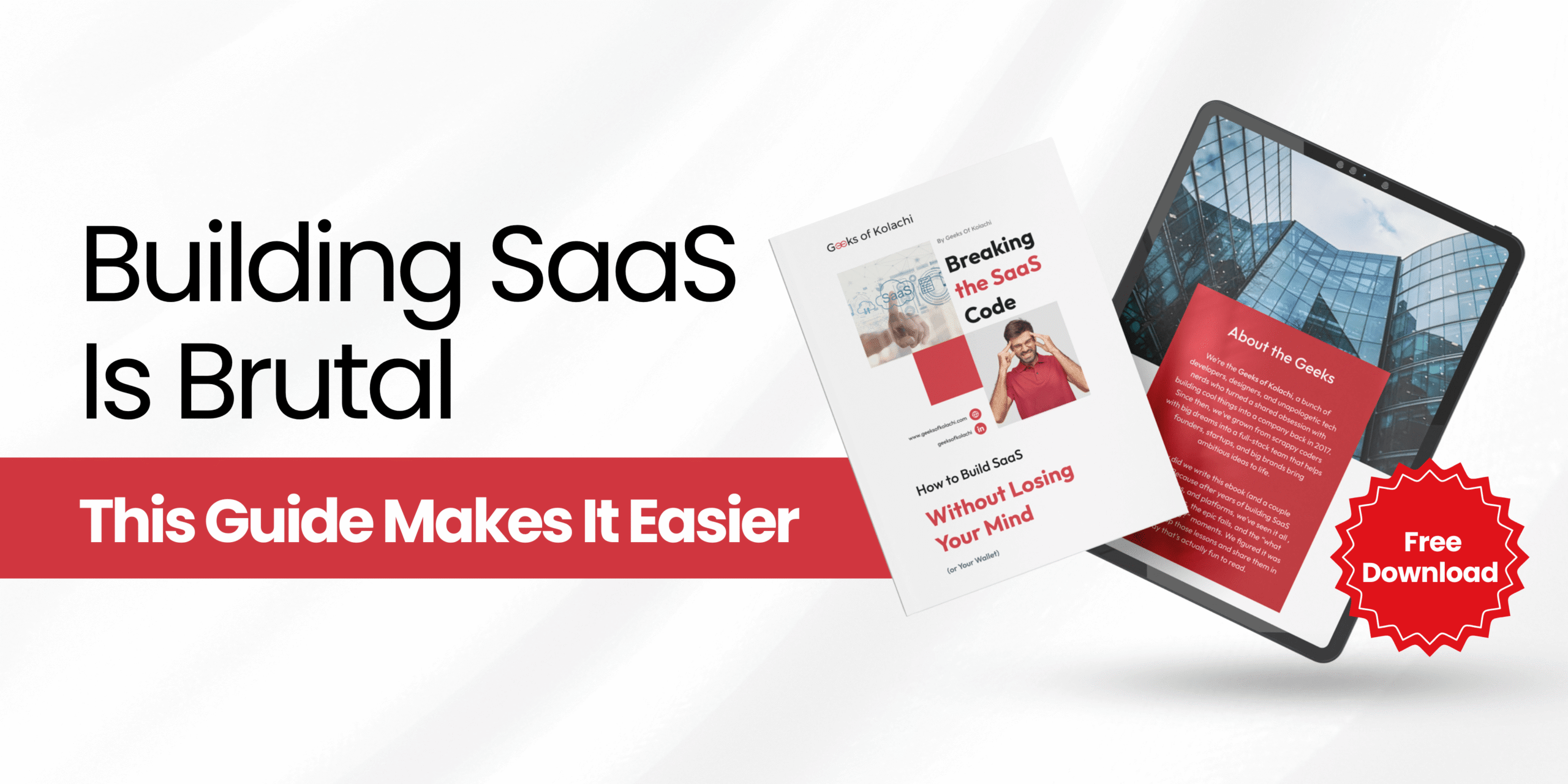
If you are navigating early-stage SaaS growth and want a structured approach to scaling decisions, this handbook provides a clear roadmap for balancing product evolution with financial sustainability.
Conclusion: Scaling Is a Systems Problem, Not a Marketing Problem
When SaaS products fail to scale, the instinct is often to push harder on growth channels. In reality, scaling is a systems issue.
It depends on:
- Strong retention
- Lean and adaptable architecture
- Disciplined roadmapping
- Phased and strategic custom app development
Scaling magnifies what already exists. If your foundation is solid, growth accelerates naturally. If your foundation is unstable, scaling only exposes weaknesses faster.
The brutal fix is not glamorous. It requires auditing your product honestly, removing unnecessary complexity, aligning development with revenue drivers, and rebuilding clarity into your roadmap.
Once those elements are in place, growth becomes sustainable instead of stressful.
If your SaaS is ready to move from fragile growth to structured scale, the next step is not adding more features. It is strengthening the system underneath them.